Monday, 14 December 2015

Rise in UK web users blocking ads, research finds

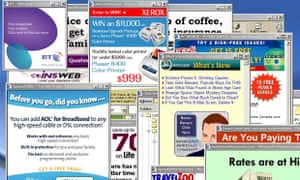
Popups

More than 1.3m people have adopted technology that blocks online ads since June, with young people more likely to turn off intrusive pop-ups and videos

Though the rise is modest, it suggests dissatisfaction with ads is growing, especially among the young, with 35% of 18- to 24-year-olds saying they blocked ads, compared to just 15% of over 55s.

Though most of the coverage of ad blocking has focused on mobile devices, few are blocking ads on their smartphones: 4.1% now compared to 2.9% in June. Just 23% of people using ad blockers do so on their smartphones, compared to 71% who say they block ads on a laptop.

BBC to confirm it will extend 10pm news by 10 minutes

Huw Edwards presents the BBC news: the 10pm bulletin will be extended from the new year

The BBC is to extend its 10pm news programme by 10 minutes, beginning in January, in a move which will increase regional and national news in its flagship bulletin.
The longer bulletin, which will run from Monday to Thursday, comes after a five-month trial in the run-up to the general election which proved popular with viewers, according to the BBC.
“Through research, our audience has told us that they want more from our evening news service. The format we first tried before the election allows audiences to see more regional stories and gives us the opportunity to get under the skin of the issues alongside content that reflects arts and culture in different parts of the UK.”
This hsows how social media and online news has not only created a decline in newspapers but also starting to kill TV news broadcasts.

What are Facebook and other social media doing about Donald Trump?

Donald Trump

The US woke up on Friday to the news that Donald Trump was a full 20 percentage points ahead of Ted Cruz, his nearest rival, for the Republican nomination, and a good 16 percentage points higher than America’s top political analysts thought he would be.


Running on a platform of “making America great again”, his campaign has been noteworthy for Trump’s egregious widespread insults and total fabrications, on a gargantuan scale. The most recent of which was him claiming to have seen “thousands of Muslims” dancing in the streets of New Jersey after 9/11. No evidence exists of this, because it never happened.

Donald Trump has so far spent a mere $217,000 on broadcast advertising, compared to the eye-watering $28.9m spent by Jeb Bush, currently languishing at 3% of the poll compared with Trump’s 36%. Trump is allowing the evolved ecology of TV coverage and the new power of the social web do the work for him, live tweeting along the way.

When it is possible to remove all traces of a campaign claim which is completely untrue, and demonstrably so, by building verifiability into the algorithm, will social platforms and search engines go ahead and do it? 

What he meant was, should reporters report something even if they know it to be false?
Facebook rolls out live streaming video service

A phone showing Facebook Live Video

Facebook has begun rolling out a new feature on its social network which allows users to stream live video.

A select group of celebrities and high profile users have been able to use the service for several months.
Live streaming via mobile phones has become one of the big technology trends of the year, with Twitter-owned Periscope and Meerkat proving popular.
Last year, Amazon paid $1bn for live streaming game site Twitch.
Initially Facebook's live video feature will be available only to a small percentage of people in the US and will be limited to iPhones.
The tech giant said that "over time, the company plans to bring it to all users" but it did not give specific timescales.

NDM News Index:

1) Institution: the impact of Google on the newspaper industry
2) Audience and Institution: how news consumption has changed
3) The future of newspapers: Build The Wall analysis
4) The decline of newspapers: the effect of online technology
5) Citizen journalism: Media Magazine article and questions
6) News Values: theory and updating them for digital media landcape
7) Marxism & Pluralism: Media Magazine article and questions
8) Media Conference: notes from speakers
9) Marxism and Pluralism: views and values question
10) NDM Section B essay on blog - consumption and production question
11) Marxism and Pluralism: Alain de Botton on the news - lecture and questions
12) Globalisation: questions and blog task
13) Globalisation: Media Magazine - Google Glass, techno-panics and data mining
14) News on the Tweet report and questions
15) Audience and Institution article and questions
16) Institution case study: NDM and News Corporation

NDM: The key concepts of audience and institution

1) What was the relationship between audience and institution in the pre-digital age?
"In the past, this relationship was seen as a power relationship, where most of the power was in the hands of the institutions. This model was based on the idea that the audience was passive and received information from powerful institutions."

2) The article gives a lot of examples of major media institutions. Choose three examples from the article and summarise what the writer is saying about each of them.
Google, Netflix, Facebook.
Google now owns youtube, Netflix now produces its own TV shows & facebook bought oculus rift. Shows how these mass companies are continuing to expand and adapt making them much more globalised, it suggests that we will be consuming media from a smaller variety of institutions.
3) The article ends with a section on the digital age. Summarise this section in 50 words.
The article suggests how organisations have to adapt to survive, they are finding more and more creative ways to stay in the market but to also attract more audiences.survive. "It is clear that not all traditional media forms, outlets or institutions will be able to maintain their place in the media marketplace. As audiences reject traditional TV programming, newspapers and cinema exhibition."

4) How do YOU see the relationship between audience and institution in the future? Will audiences gain increasing power or will the major global media institutions hold sway?
I believe that institutions will always be most dominant between the relationship with audiences. As these companies start to become more and more wealthier, smaller companies on the rise give in as these big companies will buy them outright. I believe this will continue to happen in the future as companies like Google, Facebook & Apple are far too powerful in the industry.

Friday, 11 December 2015

Can broadcast TV match streaming’s big budget shows?

Filming of 'The Crown'
Netflix and Amazon can focus on blockbusters but others have schedules to fill.

“We have to provide something that is not normal telly – something that is going to surprise and delight our customers, and very often it’s different because it’s bigger,” says Chris Bird, film and TV strategy director for Amazon Video UK.

This article shows how new and digital media such as netflix and TV streaming has taken over TV as a whole. This is because they are making their own TV shows, which are different and unique. This is due to the high budgets they are spending on these TV shows, something broadcast tv isn't doing. This means that more and more TV viewers may be switching to Tv streaming as they are able to get exclusive, brand new TV shows that are actually very good. Good examples would be Narcos, House Of Cards & Better Call Saul.